
Adani Data Networks said it plans to create a private 5G network for its operations. However, it acquired the spectrum in the last 5G auction alongside three telecom companies. Subsequently, it was granted a unified licence for access services, which enables it to provide telecom services in the country.

Amid a big push for the Aatmanirbhar Bharat scheme of Prime Minister Narendra Modi-led government, the Indian Air Force is planning to acquire 114 fighter jets of which 96 would be built in India, and rest 18 would be imported from the foreign vendor chosen for the project.

India's services sector output growth touched a three-month high in November as business inflows rose markedly amid accommodative demand conditions, a monthly survey said on Monday. The seasonally adjusted S&P Global India Services PMI Business Activity Index rose from 55.1 in October to 56.4 in November, indicating a sharp increase in output that was the quickest in three months even amid higher operating expenses. Survey participants linked the latest expansion to demand strength, successful marketing and a sustained upturn in sales.

A few days ago, Reliance Retail surprised the market by acquiring the Campa brand from Delhi-based Pure Drinks Ltd for Rs 22 crore. A successful cola brand in the eighties, especially in North India, Campa Cola thrived when Coke exited India in the late seventies. When the Atlanta-based major returned and PepsiCo set base in India, it went down fighting.

While traditional automakers in India are reeling under a global shortage of semiconductors, the country's electric vehicle (EV) makers, too, are now facing a shortage of lithium-ion batteries, a key raw material. The soaring prices of metals like lithium, nickel and cobalt, which are the primary constituents of the cell, as well as supply chain bottlenecks, are also pushing up the cost of batteries. Battery manufacturers say that prices have been increasing every quarter since the beginning of 2021.

Benchmark Sensex declined 224 points on Wednesday, snapping its four-session winning streak, mainly due to sell-off in IT and pharma counters amid rising concerns over possible aggressive interest rate hikes to tame high inflation. The 30-share index rebounded more than 1,200 points from the early lows before settling at 60,346.97 points, a total loss of 224.11 points or 0.37 per cent compared to Tuesday's closing level. The broader NSE Nifty closed lower 66.30 points or 0.37 per cent at 18,003.75 points.

Creating domestic demand through investment in sectors like construction and mass housing can get the economy back on a high growth path, Commerce and Industry Minister Kamal Nath said on Monday.

Carmakers Mercedes-Benz, Audi, Renault, Kia India and MG Motor on Wednesday announced plans to hike vehicle prices from January to partially offset the impact of rising input costs. They join the likes of market leader Maruti Suzuki India and Tata Motors, which have also made the year-end announcements to raise prices from next month. Audi India said it will increase prices of its entire model range by up to 1.7 per cent, while Mercedes-Benz India noted it will hike the prices by up to 5 per cent from January 1.

In a major push towards 'Make in India', Apple Inc is manufacturing 70 per cent of the mobile phones, in value terms, that it sells in the domestic market, in India, according to sources aware of the development. This is a sharp rise from the figure of 30 per cent just two years ago and marks a major shift in Apple's strategy following the government's Production Linked Incentive (PLI) scheme that kicked off in FY'21. One of Apple's three vendors here, Foxconn, is currently manufacturing the best-selling model, the Apple 11, along with the Apple 10 and the Apple 12. Another contract manufacturer, Wistron, makes the Apple SE 2020. (The third, Pegatron, has yet to start production). The only models that are imported (they have limited volumes but high value) are the Apple 12 Pro and Pro Max.

Our focus is not on substance, but communicating how we did not shake hands and how we made angry faces. This is what India's foreign policy has become, notes Aakar Patel.

Finance Minister Arun Jaitley on Wednesday said the country is on an "upward curve" and a good monsoon, GST passage and increased infra and rural spending will further accelerate the growth.

The question is: Will the company have a strong balance sheet to support this massive investment plan?

The primary and immediate impact of a depreciating rupee is on the importers who will have to shell out more for the same quantity and price. However, it is a boon for the exporters as they receive more rupees in exchange for dollars. The rupee depreciation has wiped away some of the gains that would have accrued to India from international oil and fuel prices dropping to pre-Ukraine war levels.

Chinese giant Xiaomi is going for the premium segment with a view to grabbing market share in the Rs 20,000 to Rs 50,000 smart phone market as well as having offerings up to Rs 70,000 where players like One Plus, Samsung, Vivo and Apple are key players. "Two years ago, the Rs 20,000 plus smart phone market which is considered premium in India was very small. "Out of every 100 phones sold, only 10 were above this price mark. "However, in the last two years, it suddenly grew and we thought it was big enough for us to focus on now," said Manu Kumar Jain, managing director, Xiaomi India.
'Limited spillovers' to Asia's third-largest economy, even as world 'perilously close' to recession.

'The Modi visit will prove to be the watershed where India and the United States commenced technology trade and transfer.'

Moody's Investors Service on Thursday said India's rising vaccination rate, low interest rates and higher public spending drive the positive outlook for corporate sector.

New projects fell 6.3 per cent in the December quarter compared with the September quarter. The value of new projects in the just-concluded quarter was Rs 2.1 trillion, according to the data from Centre for Monitoring Indian Economy (CMIE), which was lower than the Rs 2.2 trillion seen in the September quarter. It is, however, higher than Rs 1.5 trillion recorded for the quarter ended December 2020, the first year of the Covid-19 pandemic. This data ties in with the November data for core sector growth, an index of eight core industries, which grew at its slowest pace since early 2021.

'In FY23, PV sales are expected to end the year at a record 3.8 million units, up 26 per cent. In FY24, however, the industry is expecting 5-7 per cent volume growth'

India will have 1 billion smartphone users by 2026 with rural areas driving the sale of internet-enabled phones, a Deloitte study said on Tuesday. India had 1.2 billion mobile subscribers in 2021, of which about 750 million are smartphone users. It is poised to be the second-largest smartphone manufacturer in the next five years. "The smartphone market is expected to reach 1 billion smartphone users by 2026," according to Deloitte's 2022 Global TMT (Technology, Media and Entertainment, Telecom) predictions.

'If we are to be a contributor to the economy, we have to reduce carbon and imports.' 'We will achieve both -- that's our target.'

'We seem to be in a situation where we can do little, and nothing needs to be done anyway.'

If even a fraction of the 175 GW target is achieved, India's reliance on coal and oil would be reduced, says expert.

'It leads to more investment, more money put in R&D, expansion and modernisation.'

Competition in the US pharmaceutical market swelled in recent years, with increasing generic penetration.

The defence ministry said 10 helicopters will be for the Indian Air Force and five will be for the Indian Army.

India will soon become a green hydrogen exporting country, the road transport and highways minister told reporters before leaving for Parliament in the car, which is the first of its kind in India.

Bold reforms and prudent monetary and fiscal policies by the incoming Narendra Modi government will help the economy to grow at 6.5-7 percent, says a report.

Onion prices, however, continued to rule high with 79.78 per cent increase in September.

Chief Economic Adviser K V Subramanian on Wednesday said India is expected to hit a growth rate of 6.5-7 per cent in 2022-23 and accelerate further to 8 per cent in the subsequent years on the back of reforms undertaken by the government. He also said the government is expected to meet the fiscal deficit target of 6.8 per cent in the current fiscal despite pressure on revenue collections.

On August 15 last year, Prime Minister Narendra Modi announced from the ramparts of the Red Fort that the Indian Railways would launch 75 Vande Bharat Express trains by August 2023. Later, in her 2022 Budget speech, Finance Minister Nirmala Sitharaman announced that 400 Vande Bharat trains will be manufactured in the next three years, which are expected to cost between Rs 40,000 crore and Rs 50,000 crore. Those upbeat announcements come after a series of cancelled tenders, vigilance actions against officials and interdepartmental rivalry that delayed the addition of these iconic trains developed entirely indigenously by the Integral Coach Factory (ICF) in Chennai.

For India, struggling for competitiveness, the current rupee overvaluation in terms of real effective exchange rate is a genuine constraint.

The attorney general admitted that there is no sovereign guarantee, but asserted that there is a letter of comfort by France which would be as good as a governmental guarantee.
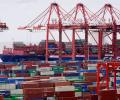
After staging a strong recovery from COVID-induced slowdown in 2021, India's exports are likely to extend the growth story to the New Year also on increased demand in the global markets, boost in domestic manufacturing due to production-linked incentive schemes and implementation of some interim trade pacts. Expectations of positive growth in the country's exports are also backed up by the outlook of the World Trade Organisation (WTO) which predicts a 4.7 per cent expansion in the global merchandise trade volume in 2022. Exporters believe that the outbound shipments would cross $400 billion mark in this fiscal going by the current momentum and may reach $475 billion in 2022-23.

Services sector activities improved further and touched a five-month high in April driven by a surge in incoming new work orders that boosted business activity and supported a renewed increase in employment, according to a survey. The seasonally adjusted S&P Global India Services PMI Business Activity Index jumped to 57.9 in April, from 53.6 in March, highlighting a sharp rate of expansion that was the fastest since last November amid mounting price pressures. For the ninth straight month, the services sector witnessed an expansion in output.

Hindustan Unilever (HUL), one of the country's largest fast-moving consumer goods (FMCG) players, is learnt to have cut prices of its leading soaps and detergents this month by 2-19 per cent, according to the company's distributors. The cuts come after consistent price increases by the company as well as its peers, following the sharp rise in raw material prices in the past several months. It is only recently that prices of raw materials have started to correct from peak levels in the June quarter.
The seasonally adjusted India Services Business Activity Index rose from 45.4 in July to 56.7 in August, as the reopening of several establishments and increased consumer footfall boosted sales. The services sector witnessed the first expansion in output in four months and a rebound in business confidence.

India's merchandise exports in June rose by 16.78 per cent year-on-year to $37.94 billion while the trade deficit ballooned to a record $25.63 billion on account of a steep increase in gold and crude oil imports, according to the government's preliminary data released on Monday. The export growth in June moderated from 20.55 per cent in May and 48.34 per cent in June 2021. During the month under review, exports of engineering, pharmaceutical and plastic products recorded negative growth.
 © 2026 Rediff.com - Advertise with us - Disclaimer - Privacy Policy - Sitemap - Feedback - About us - Terms of use - Grievances